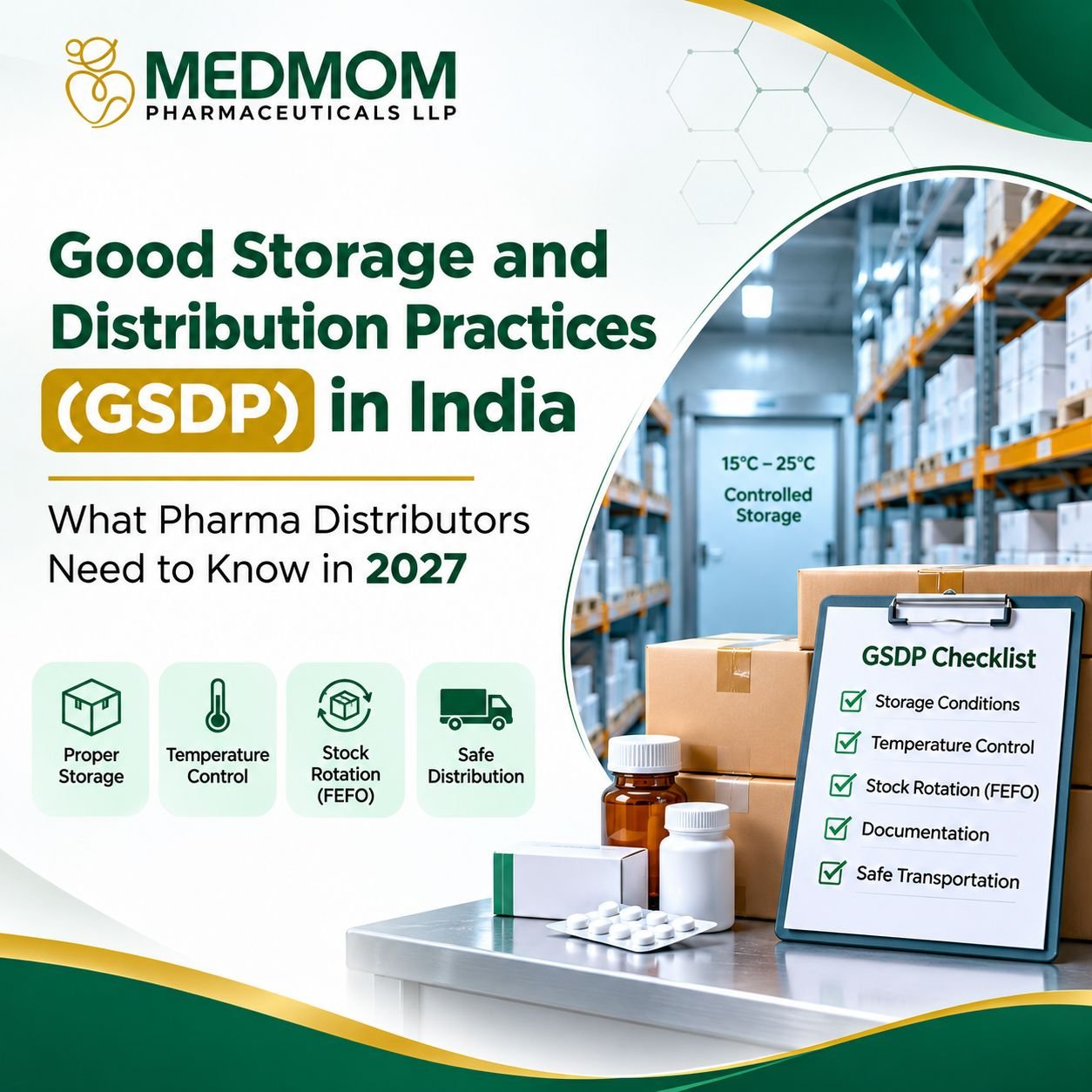
The pharmaceutical business is not only about manufacturing good-quality medicines. It is equally important to make sure that medicines remain safe and maintain their quality until they reach pharmacies, hospitals and patients.
Think about a simple situation. A Pharma medicine is manufactured under proper quality conditions, packed carefully and dispatched from a company. But during transportation, it is exposed to excessive heat. Later, it is stored in a warehouse without proper temperature control. Even if the medicine was manufactured correctly, poor storage and handling can affect its quality.
This is why Good Storage and Distribution Practices (GSDP) in India are becoming an important topic for pharmaceutical manufacturers, wholesalers, distributors and stockists.
On 19 November 2026, the Union Ministry of Health and Family Welfare announced a proposal to incorporate Good Storage and Distribution Practices into the Drugs Rules, 1945. This development is especially relevant for businesses involved in pharmaceutical distribution.
In this article, we will explain what GSDP means, why it matters, what the latest government proposal says and how pharmaceutical distributors can prepare for better storage and distribution practices in 2027.
What Are Good Storage and Distribution Practices (GSDP)?
Good Storage and Distribution Practices, commonly known as GSDP, refer to the practices followed to maintain the quality, safety and identity of pharmaceutical products during storage, handling and transportation.
A Pharma medicine passes through several stages before reaching the customer. It may move from a manufacturer to a distributor, then to a wholesaler, stockist, pharmacy or hospital.
At every stage, the product needs proper handling.
For example:
- Medicines should be stored according to the conditions mentioned by the manufacturer.
- Products should be protected from excessive heat, moisture and direct sunlight where required.
- Expiry dates and batch numbers should be checked.
- Medicines should be purchased from authorised suppliers.
- Damaged or suspicious products should be separated.
- Stock movement should be properly recorded.
- Transportation should protect medicines from unsuitable conditions.
The main purpose of GSDP is simple: the quality achieved during manufacturing should be maintained throughout the supply chain.
It is not just about keeping medicines inside a warehouse. It covers the complete process & Pharma Distributor Guide 2027, from purchasing and receiving products to storage, dispatch, transportation and record-keeping.
Why Is GSDP Important for the Indian Pharmaceutical Industry?
India has a large pharmaceutical manufacturing and distribution network. Medicines travel across cities, states and different climatic conditions before reaching their final destination.
A distributor handling medicines in North India may face different storage challenges during summer compared with someone operating in a cooler region.
Similarly, Pharma Distributor Guide 2027, products requiring refrigerated storage need more attention than products that can be stored at controlled room temperature.
Here are some important reasons why Good Storage and Distribution Practices in India matter.
1. Maintaining Medicine Quality
Every pharmaceutical product has specific storage requirements.
If a medicine is exposed to unsuitable temperatures or moisture, its quality may be affected. The extent of the impact depends on the product and the conditions involved.
Proper storage helps maintain the product within its approved specifications throughout its shelf life.
2. Preventing Damaged and Expired Stock
Poor stock management can lead to expired medicines, damaged packaging and unnecessary financial losses.
Regular checking, proper stock rotation and expiry monitoring help distributors manage inventory more effectively.
3. Improving Supply Chain Transparency
A distributor should be able to identify where a medicine came from, which batch was received and where that batch was supplied.
Proper records make it easier to trace products when there is a complaint, quality issue or recall.
4. Reducing the Risk of Counterfeit Medicines
Purchasing medicines from unknown or unauthorised sources can create serious risks.
Maintaining supplier records, checking product details and keeping proper purchase documents can help reduce the chances of suspicious products entering the supply chain.
5. Building Trust With Pharmacies and Healthcare Providers
Pharmacies and hospitals depend on reliable suppliers.
When distributors maintain proper stock, handle products carefully and provide accurate documentation, they build stronger business relationships.
Latest GSDP Update in India: What Happened in November 2026?
This is one of the most important developments for pharmaceutical distributors to understand before 2027. Pharma Distributor Guide 2027
The Ministry of Health and Family Welfare published draft notification G.S.R. 984(E), dated 4 November 2026, in the Gazette of India on 12 November 2026.
On 19 November 2026, the Ministry also issued a public announcement explaining its proposal to incorporate Good Storage and Distribution Practices into the Drugs Rules, 1945.
The proposal is intended to strengthen accountability across the pharmaceutical supply chain.
It covers important activities such as:
- Procurement and purchasing of medicines.
- Storage and warehouse management.
- Distribution and transportation.
- Documentation and record-keeping.
- Traceability of pharmaceutical products.
- Maintaining product quality and identity throughout distribution.
Is GSDP Mandatory in India Now?
This is an important question, and distributors should understand the difference between a draft notification and a final rule.
As of 20 November 2026, the proposed GSDP amendment is still a draft. It should not be described as an already-finalised amendment.
The draft proposes adding GSDP compliance requirements to several provisions of the Drugs Rules, 1945, including Rules 26, 33A, 65, 74, 74A, 74B, 78, 78A and 122P.
The draft also states that the amendment would come into force from the date specified by the Government at the time of final publication.
This means businesses should follow the existing applicable drug licensing and storage requirements while preparing for the proposed changes.
It is sensible to improve warehouse practices, documentation and transportation controls now rather than wait for the final notification.
10 Important GSDP Practices Every Pharma Distributor Should Follow
Good pharmaceutical distribution does not always require complicated systems. Many important improvements begin with simple daily procedures.
Let’s understand the practices that can help distributors prepare for stronger quality management.
1. Maintain Proper Warehouse Conditions
A pharmaceutical warehouse should be clean, organised and suitable for storing medicines.
Products should not be placed directly on the floor. Suitable racks and pallets can help protect stock from dust, moisture and accidental damage.
The warehouse should have:
- Proper ventilation.
- Clean floors and storage areas.
- Suitable lighting.
- Protection from direct sunlight.
- Pest-control arrangements.
- Fire safety equipment.
- Restricted access where necessary.
The storage area should also have enough space to keep different product categories organised.
2. Monitor Temperature and Humidity
Temperature control is one of the most important parts of pharmaceutical storage.
Different medicines have different storage requirements. Some products can be stored at controlled room temperature, while others require refrigeration.
Distributors should always check the storage instructions printed on the product label and the manufacturer’s recommendations.
For example, the WHO technical guidance gives the following recommended storage descriptions:
| Storage description | WHO recommended limits |
|---|---|
| Controlled room temperature | 15°C to 25°C |
| Cool place | 8°C to 15°C |
| Refrigerator | 5°C ± 3°C |
| Freezer | -20°C ± 5°C |
These are WHO guidance values, not universal instructions for every medicine. The product label and manufacturer-approved storage conditions must always be followed.
Temperature and humidity should be monitored at suitable intervals. Monitoring equipment should be appropriate for its purpose and calibrated.
For larger warehouses, temperature mapping can help identify areas that may become warmer or cooler than expected.
3. Follow FEFO Stock Management
One common problem in pharmaceutical distribution is the accumulation of near-expiry stock.
A useful method is FEFO, which means First Expiry, First Out.
Under this method, products with the earliest expiry dates are issued before identical products with later expiry dates.
For example:
| Product batch | Expiry date | Stock priority |
|---|---|---|
| Batch A | March 2027 | First |
| Batch B | August 2027 | Second |
| Batch C | December 2027 | Third |
Even if Batch C arrived earlier, Batch A should receive priority because its expiry date is approaching sooner.
FEFO helps reduce avoidable expiry losses and improves stock rotation.
4. Check Medicines During Receiving
Every incoming delivery should be checked before it is placed in the main storage area.
The receiving team should verify:
- Product name and strength.
- Quantity received.
- Batch number.
- Manufacturing and expiry dates.
- Supplier details.
- Packaging condition.
- Signs of leakage or damage.
- Storage requirements.
If any product looks suspicious or damaged, it should be separated and investigated instead of being mixed with usable stock.
5. Purchase From Authorised Suppliers
A pharmaceutical distributor should maintain proper supplier records.
Purchasing medicines only from appropriate authorised sources helps reduce the risk of counterfeit, unapproved or improperly sourced products.
Before starting business with a supplier, check the relevant drug licence and other applicable credentials.
Keep purchase invoices, product details and batch information safely recorded.
6. Maintain Proper Documentation
Documentation is an important part of Good Distribution Practices.
A distributor should be able to identify the source of a product and the customers to whom it was supplied.
Useful records include:
- Purchase invoices.
- Sales invoices.
- Batch numbers.
- Product quantities.
- Expiry dates.
- Supplier information.
- Customer information.
- Temperature records.
- Damaged stock reports.
- Returns and recall records.
These records can be maintained using suitable software or properly organised paper registers.
The important point is that information should be accurate, readable and easy to retrieve.
7. Follow Proper Transportation Practices
Medicines should remain protected during transportation.
A vehicle carrying pharmaceutical products should be clean, suitable for the purpose and protected from conditions that may damage the products.
For example, medicines requiring special temperature conditions should be transported using suitable arrangements that can maintain those conditions.
Distributors should also consider:
- Protecting cartons from rain and direct sunlight.
- Avoiding unnecessary delays.
- Preventing physical damage.
- Maintaining product identification.
- Monitoring temperature where required.
- Keeping delivery and dispatch records.
Good transportation practices are especially important when products travel long distances.
8. Separate Damaged, Returned and Expired Medicines
Damaged or returned medicines should not be mixed with normal saleable stock.
A separate, clearly identified area should be used for products awaiting inspection or further action.
A distributor should have a written process for handling:
- Broken packaging.
- Leakage.
- Expired products.
- Customer returns.
- Suspected counterfeit medicines.
- Recalled batches.
Products should only return to saleable stock when their quality and suitability have been properly assessed under an appropriate procedure.
9. Train Employees
Even the best warehouse system will not work properly if employees do not understand their responsibilities.
Staff involved in receiving, storage, packing and dispatch should receive suitable training.
They should understand how to check expiry dates, maintain cleanliness, identify damaged products and follow storage instructions.
Training records should also be maintained.
10. Conduct Regular Warehouse Inspections
A distributor should not wait for a problem to happen before checking the warehouse.
Regular inspections help identify issues at an early stage.
A simple inspection can cover:
- Cleanliness of storage areas.
- Temperature and humidity records.
- Expiry stock.
- Damaged packaging.
- Product arrangement.
- Pest-control records.
- Fire safety.
- Documentation.
- Access control.
Any problem found should be recorded and corrective action should be taken.
GSDP Checklist for Pharmaceutical Wholesalers and Distributors
Here is a simple checklist that pharmaceutical businesses can use for an initial internal review.
| Activity | What to check |
|---|---|
| Warehouse | Clean and organised premises |
| Storage | Product-specific storage conditions |
| Temperature | Regular monitoring and records |
| Humidity | Monitoring where required |
| Inventory | FEFO stock rotation |
| Receiving | Product and batch verification |
| Suppliers | Authorised supplier records |
| Documentation | Purchase and sales records |
| Transportation | Suitable vehicles and handling |
| Returns | Separate returned and damaged stock |
| Staff | Training and assigned responsibilities |
| Inspection | Regular internal checks |
This checklist is a practical starting point, not a substitute for the complete CDSCO guidance, applicable laws or a formal compliance audit.
How Can Technology Help Pharma Distributors Follow GSDP?
Managing a pharmaceutical warehouse manually can become difficult as the business grows.
Technology can make routine activities easier and improve the accuracy of records.
For example, inventory management software can help businesses:
Track batch numbers: Identify which batch has been received and sold.
Monitor expiry dates: Receive reminders about stock approaching its expiry date.
Maintain digital records: Store purchase, sales and dispatch information.
Manage stock levels: Identify fast-moving and slow-moving products.
Monitor storage conditions: Use suitable digital temperature monitoring systems.
A small distributor does not necessarily need an expensive software system. Even a properly maintained inventory application or spreadsheet can improve daily operations.
The important thing is to have a reliable process and keep records updated.
What Should Pharma Distributors Prepare for in 2027?
With the proposed GSDP amendment attracting attention, pharmaceutical businesses should use the coming months to review their existing systems.
Here are some practical steps:
- Review the current warehouse arrangement.
- Check whether storage conditions match product labels.
- Introduce regular temperature monitoring.
- Maintain updated supplier and customer records.
- Follow FEFO for stock rotation.
- Prepare written procedures for damaged and returned products.
- Train employees on safe handling and documentation.
- Review transportation arrangements.
- Keep records ready for inspection.
- Follow updates from CDSCO and the Ministry of Health.
Businesses should also monitor the final publication of the proposed amendment and any subsequent instructions from the relevant State Drug Control Department.
The final requirements and implementation date should be confirmed from the applicable official notification.
How Medmom Pharma Supports the Pharmaceutical Business Network
At Medmom Pharma, we understand the importance of reliable pharmaceutical products and a well-managed distribution network.
Our focus is on pharmaceutical products and business opportunities for distributors and franchise partners.
Whether you are exploring pharmaceutical products, looking for a PCD pharma franchise opportunity or planning to expand your business, understanding product quality and proper distribution practices is an important starting point.
You can explore our pharmaceutical product range and learn more about our PCD Pharma Franchise opportunities.
For business-related questions, visit our About Medmom Pharma page or contact our team.
Frequently Asked Questions About GSDP in India
1. What is GSDP in the pharmaceutical industry?
GSDP stands for Good Storage and Distribution Practices. It refers to the practices used to maintain the quality, safety and identity of pharmaceutical products during purchasing, storage, handling and transportation.
2. Is GSDP mandatory for pharma distributors in India in 2026?
As of 20 November 2026, the Government has published a draft amendment proposing the incorporation of GSDP into the Drugs Rules, 1945. It should not be treated as a final implemented amendment yet. Existing applicable licensing and storage requirements continue to apply.
3. What is the role of CDSCO in GSDP?
The Central Drugs Standard Control Organisation (CDSCO) is India’s central drug regulatory authority. It developed the Good Distribution Practices guidance that forms the basis of the proposed GSDP framework.
4. What is FEFO in pharmaceutical distribution?
FEFO means First Expiry, First Out. It is a stock rotation method in which medicines with the earliest expiry dates are issued before products with later expiry dates.
5. Why is temperature monitoring important for medicines?
Some medicines can lose quality if they are exposed to unsuitable temperatures. Monitoring helps distributors identify storage problems and take corrective action when required.
6. What documents should a pharma distributor maintain?
Useful records include purchase and sales invoices, supplier and customer details, batch numbers, expiry dates, temperature records, stock registers, returns and recall documentation. The exact records required depend on applicable regulations and the nature of the business.
Conclusion
Good Storage and Distribution Practices are an important part of responsible pharmaceutical distribution.
A medicine should not only be manufactured properly; it should also be stored, handled and transported under suitable conditions until it reaches the customer.
The November 2026 GSDP proposal is an important development for India’s pharmaceutical supply chain. While the amendment is still at the draft stage, distributors can start improving their warehouse management, stock rotation, transportation and documentation practices today.
For pharmaceutical wholesalers, stockists and distributors, 2027 is a good time to focus on better systems, stronger records and responsible distribution.
Good pharmaceutical distribution is not just about delivering medicines on time. It is about protecting their quality at every step.
Explore Medmom Pharma: https://medmompharma.in/
Contact our team: https://medmompharma.in/contact/
——————————————-
For Website Design & Development | SEO Optimization & Content | UI/UX Design
Contact : Reelcrafted | View Website | +91 9815081200